March 5, 2026
Financial data analysis has a gatekeeping problem.
Every finance professional and business analyst knows this frustration. You have a critical question about your financial data:
-
Why is the average payment delay up 23% in Q4?
-
Why didn’t these two records match?
-
What is the underlying trend in our transaction volume?
But getting to the answer requires one of three painful paths:
-
Learning SQL: (Which takes months and isn’t your job).
-
Waiting for Data Engineering: (Which takes days or weeks because they are backlogged with other high-priority client tasks).
-
Doing it Manually: (Which takes hours of Excel gymnastics and is prone to human error).
This dependency creates a strategic bottleneck.
Finance teams aren’t able to reconcile at the speed of business and data engineering teams are overwhelmed with “self-service” requests that are anything but self-service.
The result? Slower decisions and missed early warnings in cash flow, reconciliation gaps, and revenue trends.
Introducing Creo: ZenStatement’s AI-Native Finance Platform
Finance is entering a new phase.
For years, we’ve relied on dashboards, BI tools, and data teams to extract insight from their own data. While these systems improved reporting, they did not remove the dependency on technical teams. They did not eliminate bottlenecks. And they did not fundamentally change how quickly finance leaders could move from question to answer.
Today, ZenStatement is launching Creo.

Creo is a secure, finance-native AI infrastructure designed to power autonomous agents that understand financial workflows end-to-end. It isn’t just a software layer. It is the intelligent engine built for CFOs who demand:
- Agents who truly understand financial logic
-
Decision-grade insights in minutes, not weeks
-
Reduced operational dependency on technical teams
- Enhanced governance and transparency with audit-ready logic
-
Enterprise-grade security where data is never used for training.
Meet your first finance-native agent under Creo: The AI Finance Analyst
Finance Analyst is the first agent built on ZenStatement’s AI Platform, Creo.
This isn’t a BI tool, a generic chatbot, or a LLM wrapper for a spreadsheet.
It is a purpose-built finance intelligence agent that understands financial logic, reconciliation workflows, and structured datasets by design.
The Analyst operates across three core pillars to handle your data from end to end:
- Transform: Standardize, structure, and enrich your data in minutes.
- Reconcile: Automatically match records and surface mismatches instantly.
- Analyse: Visualize trends, spot anomalies, and understand every number.
How it works: From raw files to audit-ready results
Powered by Creo’s deterministic logic, the Analyst handles the heavy lifting of data processing through a transparent, multi-step workflow:
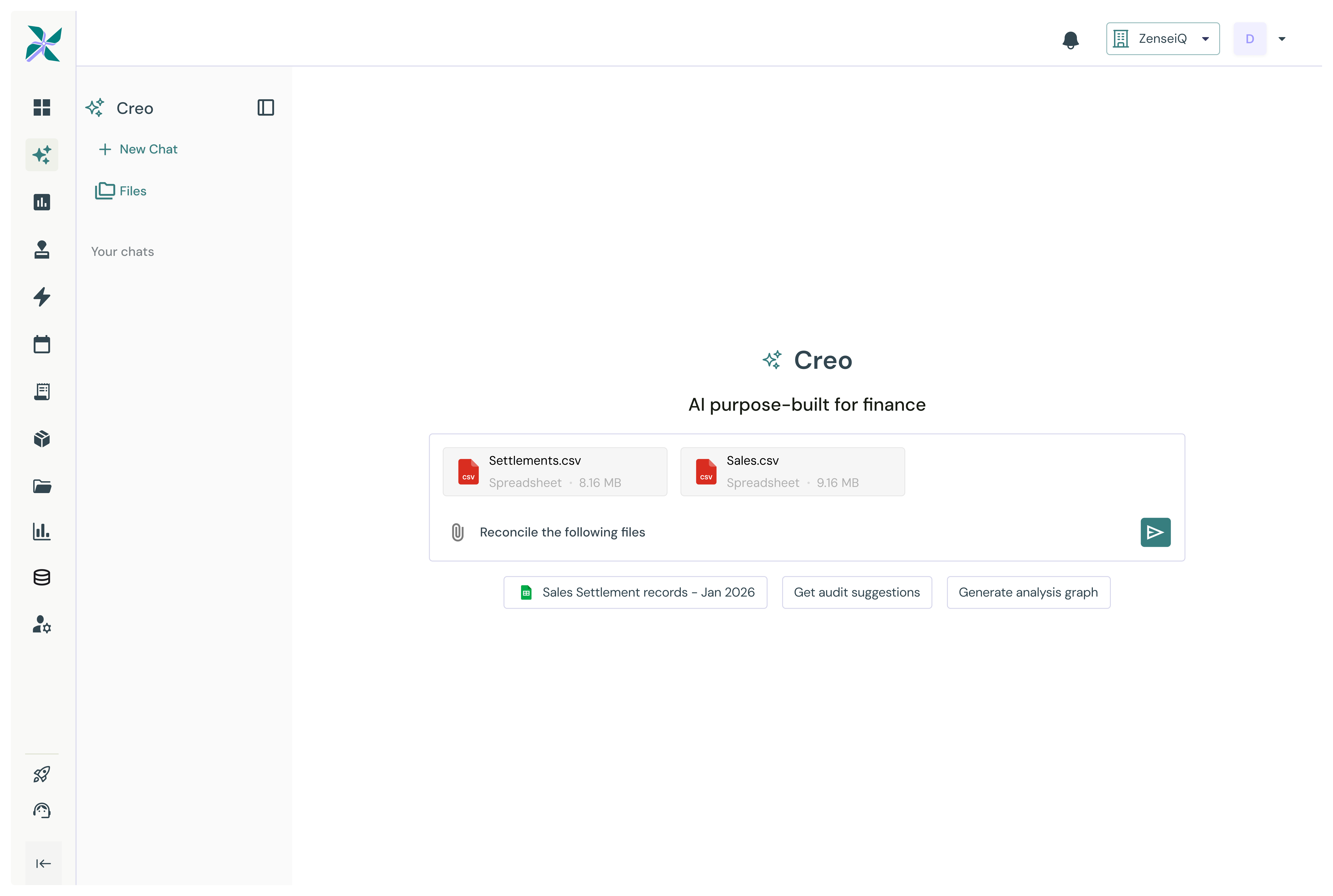
1. Effortless ingestion and natural language context
You start by simply uploading your raw files (such as sales records and settlements) and describing your goal in plain English, for example, “Reconcile the following files.” The Analyst provides a clean, chat-based interface where you can interact with your data as easily as talking to a teammate.
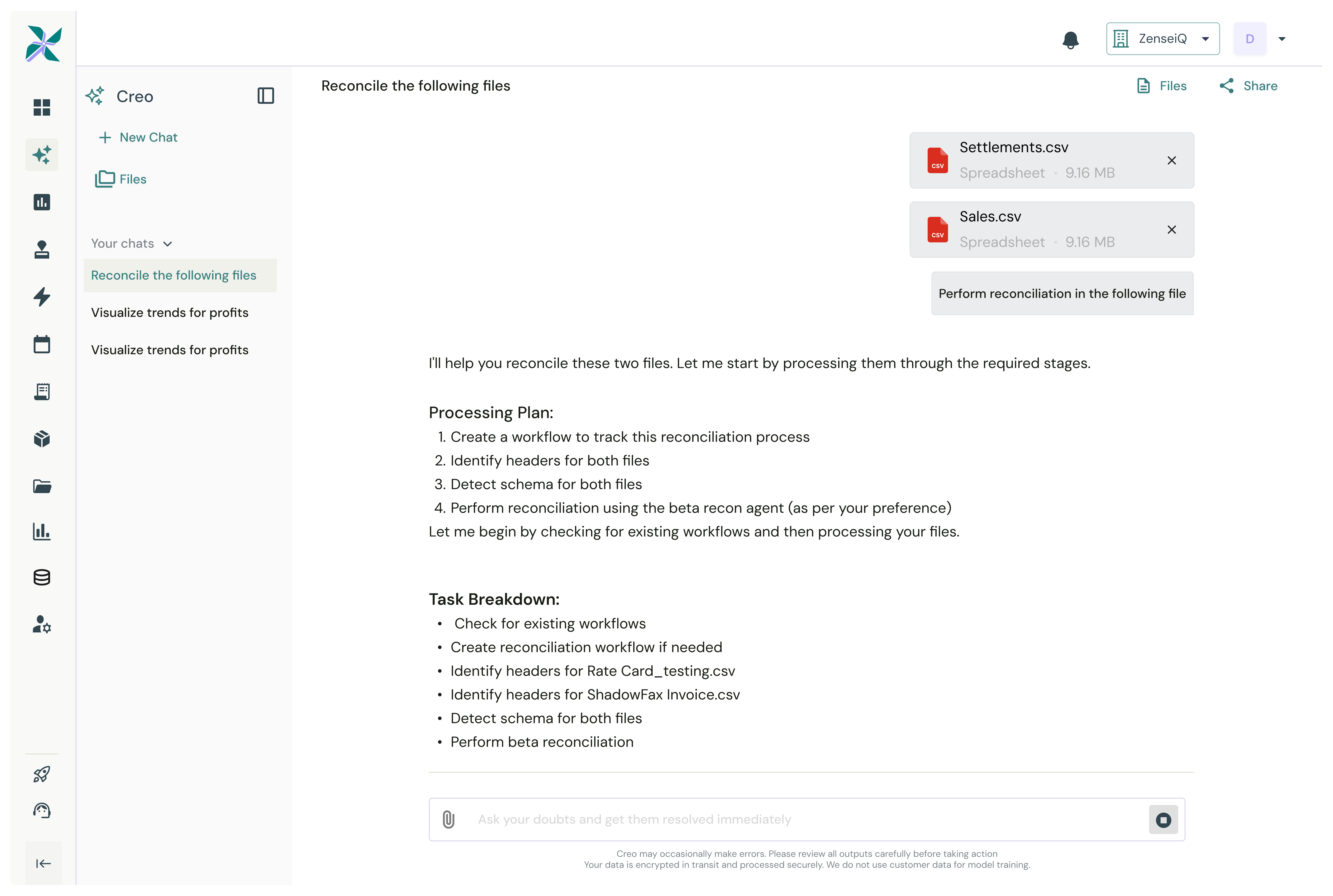
2. Intelligent planning and schema detection
Before running any analysis, the Analyst creates a processing plan. It automatically detects the schema and headers of your files, identifying which columns represent dates, amounts, or IDs without any manual mapping from you. It then provides a task breadown, showing you exactly how it intends to identify headers, detect schemas, and perform the reconciliation.
3. Precise transformation and reconciliation
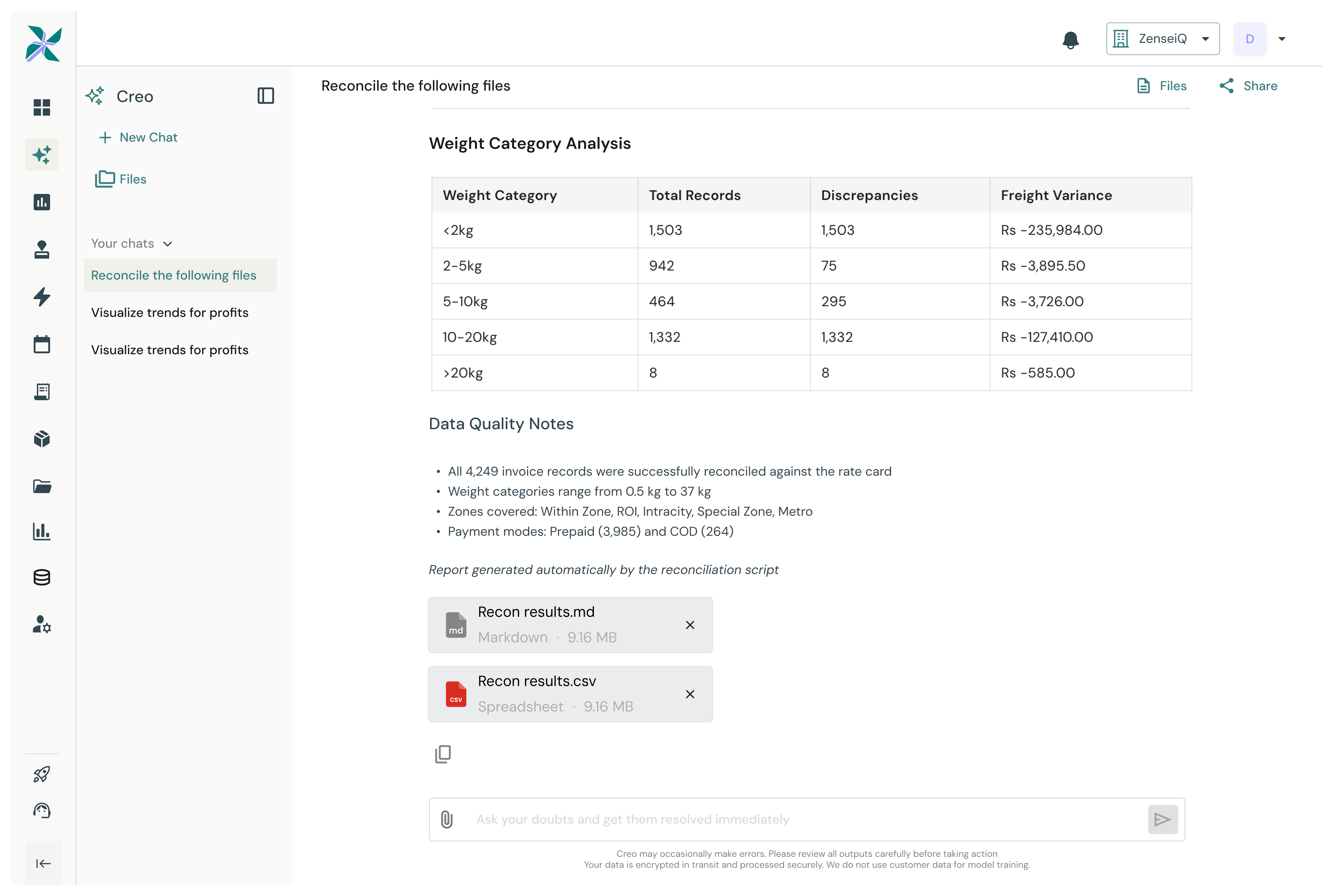
Once the plan is set, the Analyst executes the work by writing and running its own code securely. It doesn’t just “guess” matches; it calculates them. The result is a structured output that includes:
-
Deep analysis tables: For example, a “Weight Category Analysis” that breaks down records, discrepancies, and freight variance.
-
Data quality notes: The agent automatically flags total record counts, identifies specific variance ranges, and notes payment modes found in the data.
-
Downloadable deliverables: Every analysis generates audit-ready result files in both Markdown and CSV formats for your records.
4. Visual trend discovery
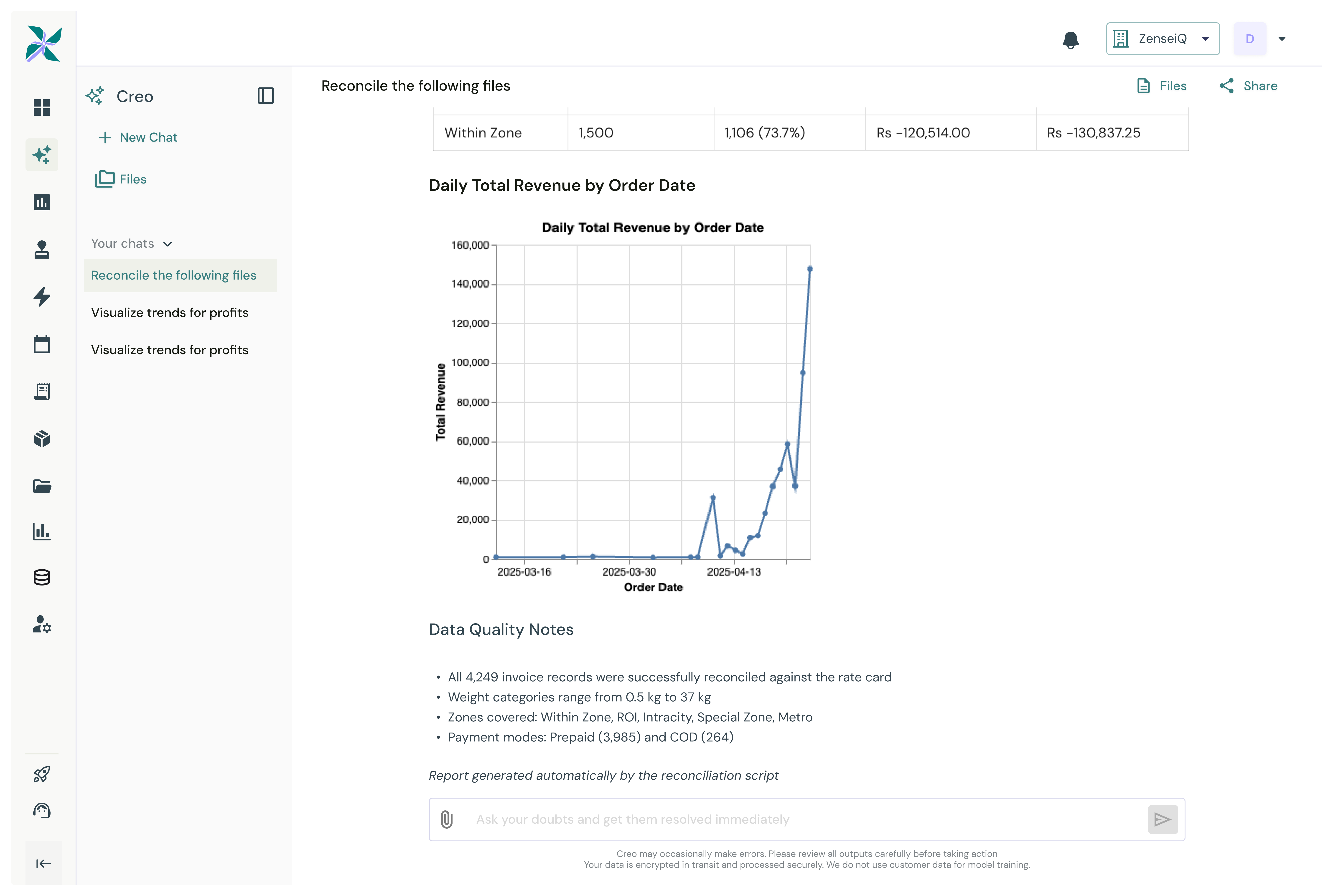
Beyond the numbers, the Analyst translates data into strategic visuals. It can instantly generate charts, such as “Daily Total Revenue by Order Date,” to help you spot growth patterns or unexpected valleys in your cash flow.
And because it is conversational, you can drill down further to ask the AI the difficult questions.
- “Why didn’t these records match?”
- “Create a corrected date column.”
- “Standardize inconsistent formats.”
- “Show trend analysis on unmatched transactions.”
The “Why” behind every result
What truly sets the AI Finance Analyst apart is its transparent audit trail. You don’t have to take the AI’s word for it; you can see the reasoning behind the analysis and the underlying SQL logic used to generate every result. It is independent, transparent, and built for the high-stakes world of finance where accuracy is non-negotiable.
This isn’t just faster analysis.
It’s independent, transparent, audit-ready financial intelligence.
What does the AI Finance Analyst enable: The real world impact
For finance teams: Instant reconciliation
Manual vendor reconciliation usually takes 2–3 hours and is a massive burnout risk.
-
The Creo shift: Upload two files → Ask “Do the recon.”
-
The impact: A finance team reconciling a $50M vendor statement that previously took 3 hours now completes the reconciliation in 10 minutes, freeing up 2 hours 50 minutes of finance team time per reconciliation. For a team performing 10 reconciliations per month, that’s 29 hours of freed-up time, nearly a full week of productivity recovered per month.
For business/ data analysts: Instant insights
Exploratory trend analysis (like customer churn patterns) used to take half a day of querying and charting.
-
The Creo shift: Upload file → Ask “Show me the sales trend and flag anomalies.”
-
The impact: A business/ data analyst exploring customer churn patterns that previously took 3 hours now completes the analysis in 5 minutes, freeing up 2 hours 55 minutes. For an analyst performing 5 exploratory analyses per week, that’s 15 hours of freed-up time, nearly 2 full days per week. It is not just time saved, but faster iteration and better informed decisions.
For operations teams: Independent analysis
No more waiting on a “ticket” to data engineering to find out why a payment failed.
-
The Creo shift: Operations teams can now perform 80% of their own analysis independently.
-
The impact: An operations team that previously submitted 20 analysis requests per month to data engineering (each taking 2-3 hours to fulfill) can now perform 80% of those analyses independently, freeing up 30-40 hours of data engineering time per month for higher-value work.
What makes ZenStatement’s AI Finance Analyst different
| Capability / Dimension | The AI Finance Analyst | vs. Traditional BI Tools (Tableau, Looker, Power BI) | vs. SQL-Based Tools (SQL IDEs, Jupyter notebooks) | vs. Manual Analysis | vs. other generic AI tools |
| How does it work | Works as a simple conversational AI with easy prompting in plain English | Requires technical expertise and pre-built dashboards | Requires writing SQL queries | Manual formulas & filters | Prompting in plain english, but doesn’t know that a date format mismatch will break your reconciliation |
| Setup required | No setup required. Just upload & ask questions. | Data modeling & dashboard configuration | Database connection & schema knowledge | Manual file cleaning & structuring | Requires detailed prompt engineering and training |
| Reconciliation | Built-in financial reconciliation logic. Natively understand finance logic | Not natively designed for recon | Must manually code reconciliation logic | Manual row-by-row comparison | No structured reconciliation engine |
| Time to insight | Minutes | Hours, just to configure | Hours to query | Hours to reconcile | Fast, but inconsistent accuracy with schema mismatches and format issues |
| Audit transparency | Full reasoning trail + query visibility | Limited to dashboard logic | Query visible, no explanation | No structured audit record, audit accuracy based on tribal knowledge | No deterministic audit trail |
| Finance-native intelligence | Built specifically for structured financial data | Generic analytics | Generic querying | Manual finance workflow | General-purpose AI, not finance-trained |
| Accuracy & consistency | Systematic logic with audit trail | Depends on dashboard design | Depends on query quality | Prone to human error | Prone to hallucination. Can assume ambiguous fields and guess intent. |
For those curious: The technology behind ZenStatement’s AI Finance Analyst
The AI Finance Analyst combines three key technologies:
- Natural language understanding: The system understands questions asked in plain English and translates them into data operations. “Reconcile these files” becomes a series of SQL queries that match records, identify discrepancies, and analyse differences.
- Intelligent data orchestration: The system orchestrates complex, multi-step analyses. For a single question, it might run 10+ queries sequentially, each building on the results of the previous query. This enables sophisticated analysis without user intervention.
- Enterprise-grade security: The system is built with security at every layer:
-
- User-specific data access controls (you can only access your own files)
- SQL injection prevention (malicious queries are blocked)
- Session-based authentication (secure login)
- Complete audit trails (every analysis is logged for compliance)
- Temporary database isolation (even if security is breached, original data is protected)
The future of financial data analysis
At ZenStatement, we believe financial data shouldn’t be locked behind technical gatekeepers. The people closest to the numbers should be the ones empowered to question, explore, and act on them.
Creo represents this shift from dependency to independence, from manual effort to intelligent automation, and from opaque processes to transparent, audit-ready insight.
When finance, operations, and analytics teams can move at the speed of thought, organizations don’t just save time, they make better decisions, catch risks earlier, and unlock the full value of their financial data. The future of financial intelligence isn’t more dashboards or more SQL. It’s accessible, secure, finance-native AI working alongside you.
This is the future of financial data analysis. And it starts today.
Experience the future of the CFO stack at ai.zenstatement.com.